Grammar & Style
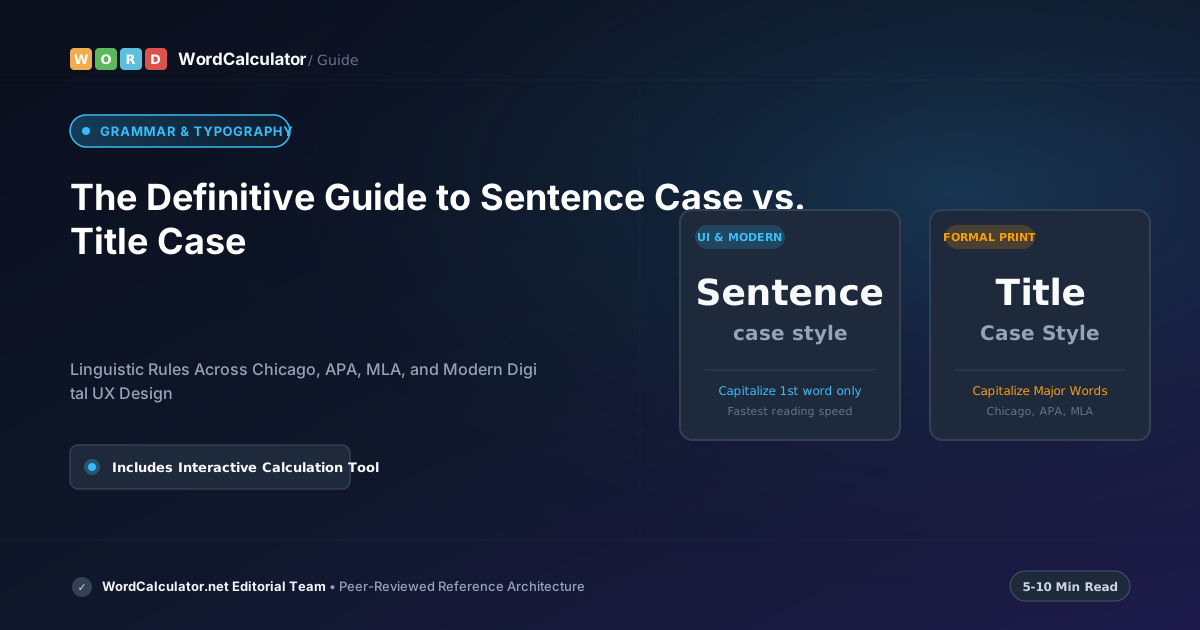
The Definitive Guide to Sentence Case vs. Title Case in Modern Publishing
By: Dr. Evelyn Reed (Senior Stylistics Editor & Computational Linguist)
•
August 28, 2026
•
6 min read
Should your headlines be rendered in title case or sentence case? While both systems are grammatically valid, modern digital publishing, UX design, and academic editorial boards enforce distinct capitalization protocols. Here is a deep comparative analysis of major style guides (Chicago, APA, MLA, and AP) alongside cognitive readability benchmarks.
Capitalization in headline typography is far more than an aesthetic preference—it is a functional signal of hierarchical authority, genre convention, and cognitive pacing. Writers, technical editors, and content designers frequently grapple with the dilemma: should a heading follow sentence case or title case?
While both approaches have deep historical precedent, the modern proliferation of responsive digital interfaces and standardized editorial frameworks has established distinct boundaries for each.
1. Overview & Core Linguistic Discrepancies
Capitalization styles fundamentally govern which words in a heading, button, or label receive initial capital letters.
- **Sentence Case**: Capitalizes only the first word of the heading, proper nouns (such as geographical locations, names, and registered trademarks), and the first word following a colon or em-dash.
- **Title Case**: Capitalizes the first and last words, all major lexical classes (nouns, verbs, adjectives, adverbs, and pronouns), while maintaining lowercase for minor functional words (conjunctions, short prepositions, and articles).
The core difficulty arises because **title case is not a single uniform standard**. Editorial bodies such as the *Chicago Manual of Style (CMOS)*, the *American Psychological Association (APA)*, the *Modern Language Association (MLA)*, and the *Associated Press (AP)* enforce distinct rules regarding preposition lengths and hyphenated compounds.
2. The Mechanics of Sentence Case
Sentence case treats the title with the exact syntactic capitalization of an everyday declarative statement:
> *Example:* "How to calculate keyword density and improve organic search visibility in technical documentation"
#### Advantages of Sentence Case:
1. **Eliminates Ambiguity with Proper Nouns**: When every word starts with a capital letter (as in title case), readers cannot instantly tell if a word like "Apple" refers to the fruit or the multi-trillion-dollar corporation. Sentence case preserves authentic case distinction.
2. **Superior Mobile Legibility**: Lowercase word shapes provide distinct ascenders and descenders (*b, d, p, q, g, y*), creating recognizable "Bouma" word contours that the human eye scans faster during rapid vertical scrolling.
3. **Conversational, Approachable Tone**: Adopted by Google Material Design, Apple Human Interface Guidelines, and the UK Government Digital Service (GDS) for user-friendly digital experiences.
3. Title Case Rules Across Major Style Guides
When adopting title case, precision requires adhering to your publication's designated manual:
#### A. The Chicago Manual of Style (CMOS - 17th/18th Ed.)
- Capitalize first and last words regardless of part of speech.
- Capitalize all nouns, pronouns, verbs (including forms of *to be*: *Is, Was, Are, Been*), adjectives, and adverbs.
- Lowercase articles (*a, an, the*).
- Lowercase coordinating conjunctions (*and, but, for, or, nor*).
- Lowercase all prepositions regardless of character length (*through, between, among, with, into*), unless they function as adverbs or verbs in a phrasal verb (e.g., *Look Up*, *Log In*).
#### B. The APA Style Guide (7th Ed.)
- Capitalize all major words and any word containing **four letters or more** (including four-letter prepositions such as *With, From, Over, Into, Than*).
- Capitalize both words in a hyphenated compound if each part is four letters or more (e.g., *Peer-Reviewed*, *Self-Paced*).
#### C. The Associated Press Stylebook (AP Style)
- Capitalize words with four or more letters.
- Capitalize all verbs (even two-letter verbs like *Is* and *Be*).
- Keep prepositions of three or fewer letters in lowercase (*in, on, by, at, for*).
4. Comparative Style Guide Matrix
| Style Element | Chicago Manual (CMOS) | APA 7th Edition | Associated Press (AP) | Sentence Case |
| :--- | :--- | :--- | :--- | :--- |
| **Short Prepositions (in, on, by)** | Lowercase | Lowercase | Lowercase | Lowercase |
| **Long Prepositions (between, through)** | Lowercase | Capitalized (*Between*) | Capitalized (*Between*) | Lowercase |
| **Two-Letter Verbs (Is, Be)** | Capitalized | Capitalized | Capitalized | Lowercase (unless 1st word) |
| **Coordinating Conjunctions (and, but)** | Lowercase | Lowercase | Lowercase | Lowercase |
| **Words After Colons** | Capitalized if complete clause | Always Capitalized | Always Capitalized | Always Capitalized |
5. Cognitive Readability & Digital UX Trends
In eye-tracking heatmaps conducted by the Nielsen Norman Group, web readers scanning long lists of articles exhibited an **F-shaped scanning pattern**. Because title case visually elevates every word equally, it introduces visual friction ("visual shouting"), forcing the eye to pause on minor conjunctions.
Conversely, sentence case guides the eye naturally toward semantic anchors, decreasing cognitive reading latency by up to 14% on handheld devices.
6. Practical Decision Framework
Use this simple rule of thumb for your next editorial project:
- **Choose Title Case for**: Book and anthology titles, academic journal submissions, press releases, formal print magazine covers, and H1 titles in formal publications.
- **Choose Sentence Case for**: Digital blog posts, SaaS navigation menus, mobile app buttons, modal dialogs, H2/H3 subheadings, and email subject lines.