SEO & Copywriting
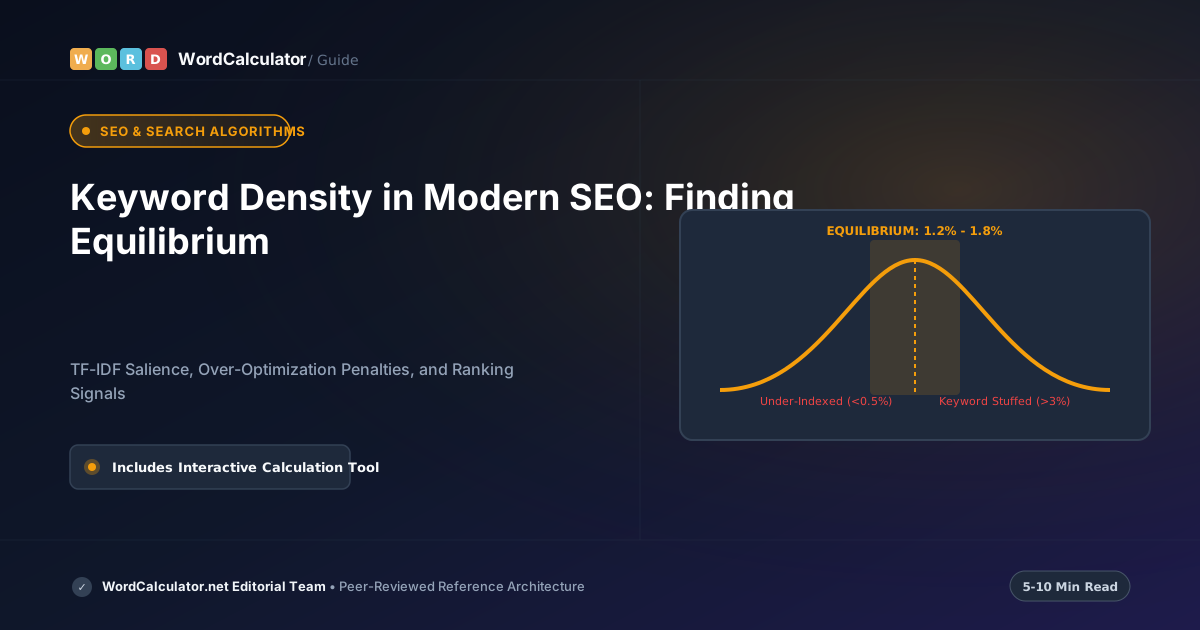
Keyword Density in Modern SEO: Finding Equilibrium Between Relevancy and Over-Optimization
By: Elena Rostova (SEO Copywriting Director & Natural Language Processing Specialist)
•
July 19, 2026
•
7 min read
Is keyword density still a relevant ranking metric in the era of semantic search and modern AI search engines? We explore the mathematical evolution from exact-match keyword ratios to TF-IDF, entity salience, and how to maintain optimal term frequency without triggering search engine algorithmic penalties.
For the first two decades of commercial search engines, SEO copywriters obsessively targeted exact keyword percentages (e.g., "maintain exactly 3.5% density"). Today, modern search ranking algorithms parse language using advanced transformer-based neural networks and entity knowledge graphs.
However, understanding keyword frequency, lexical distribution, and term prominence remains essential for creating structured, search-relevant content.
1. The Historical Shift in Search Engine Indexing
In the early 2000s, search engine spiders were essentially literal string-matching bots. If a webpage repeated the phrase *"cheap auto insurance"* 40 times in a 500-word article, the crawler inferred maximal relevance.
With the introduction of algorithmic updates targeting web spam, along with semantic breakthroughs (Knowledge Graph, RankBrain, BERT, and MUM), search algorithms transitioned from **strings to things**. Search engines now map the relationship between concepts rather than merely counting isolated tokens.
2. The Mathematical Definition of Keyword Density
Keyword density calculates the percentage of times a target keyword or phrase appears relative to the total word count of a document:
$$Keyword Density (%) = (Keyword Count * N / Total Words in Document) * 100$$
*(Where N represents the number of words in the keyphrase: N=1 for a single word, N=3 for a three-word phrase).*
#### Example Calculation:
If an 800-word article contains the two-word phrase *"word calculator"* exactly 8 times:
$$Density = (8 * 2 / 800) * 100 = (16 / 800) * 100 = 2.0%$$
3. TF-IDF & Semantic Entity Extraction
Rather than raw keyword density, modern information retrieval systems prioritize **Term Frequency-Inverse Document Frequency (TF-IDF)** and **Entity Salience**.
- **Term Frequency (TF)**: How frequently a term appears in a specific document.
- **Inverse Document Frequency (IDF)**: How common or rare that term is across the entire corpus of billions of indexed web pages.
If your document discusses *"espresso brewing"*, search engines expect to find statistically correlated co-occurring entities such as *grind size, extraction time, portafilter, crema, bar pressure,* and *water temperature*. An article that repeats *"espresso"* 50 times without mentioning *grind size* or *extraction* is mathematically flagged as low-value keyword stuffing.
4. The Mechanics of Algorithmic Over-Optimization Penalties
When an author artificially inserts keywords into every paragraph, three negative consequences occur:
1. **Elevated Syntactic Repetition**: The text feels robotic, increasing bounce rates and reducing user dwell time—critical signals monitored by user-experience algorithms.
2. **Loss of Topical Breadth**: Hyper-focusing on a single phrase prevents the natural incorporation of long-tail synonyms and sub-queries.
3. **Keyword Cannibalization**: Redundant repetition across multiple URLs confuses search crawlers regarding which page is the primary canonical authority.
5. Benchmark Thresholds for Modern Copywriters
| Keyword Type | Recommended Density Range | Placement Best Practices |
| :--- | :--- | :--- |
| **Primary Target Keyphrase** | **0.8% – 1.8%** | Title tag, H1 heading, first 100 words, one H2, URL slug, conclusion |
| **Secondary & Semantic Synonyms** | **0.3% – 0.8%** | Supporting H2/H3 subheadings, body paragraphs, bullet lists |
| **High-Risk Threshold** | **> 2.5%** | Signals potential algorithmic spam or unrefined copy |
6. A 5-Step Strategic Optimization Protocol
1. **Focus on Intent First**: Draft your initial manuscript naturally to satisfy the searcher's underlying question before checking any density meters.
2. **Audit with a Word Calculator**: Run your completed text through an analyzer to identify unintentional word loops or filler words.
3. **Incorporate Natural Synonyms**: If your focus keyword is *"speed reading"*, rotate with *"rapid reading techniques", "reading comprehension rates",* and *"words per minute"*.
4. **Optimize Key Real Estate**: Place the primary keyword in structural anchor points (H1, intro, meta title) rather than stuffing body text.
5. **Read Aloud for Cadence**: If a sentence feels unnatural when spoken aloud, rephrase it immediately.